Why I Read
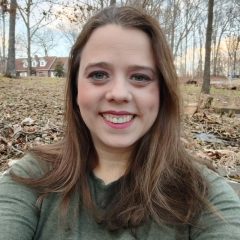
Katherine Evans (March 2023) I read for many reasons. As a child, I found tremendous comfort in books. I have no doubt that this comfort stemmed from hours spent being read to, curled up next to one or both of my parents. There was never any shortage of books in my home, and my little family could often be found all reading together. In my early childhood, stories at face value were largely for entertainment. It wasn’t until I was older that I realized that each book contained its own lesson about how to be in the world. I still remember my personal triumph of independently reading my first chapter box, The Chalk Box Kid, by Clyde Robert Bulla. I was in the first grade and realized that I was no longer dependent on someone else to read the “big” books to me. My picture books were still priceless (I still have many of them), but my newfound ability to read longer, more complex books left me thrilled. I was an anxious kid, prone to panic attacks by the age of nine, and had a tendency to worry over things far beyond my control. Reading relieved a tremendous amount of that anxiety. Very simply, the stories were a delightful distraction. I became the girl who carried a book everywhere. They became both a source of entertainment and a way to calm myself. This was years before cell phones and the Internet. Without a book to distract me, I spent entirely too much time working myself up over intrusively negative thoughts. At school, books were not only required but also served as a way to ignore my least favorite subject (math). I was well behaved, but often got in trouble for reading instead of focusing on lessons and work. My love of reading did not decrease as I got older. I read and re-read my favorite series (The Baby-Sitters Club by Ann M. Martin, Thoroughbred by Joanna Campbell, Sweet Valley Kids/High by Francine Pascal, and Fear Street by R.L. Stine). I developed a love of historical fiction and any book about horses. Between my local library and my parents’ generosity, I stayed constantly supplied with books. My friend and I developed an unspoken competition about who could work their way through the annual Bluebonnet Award list every year. I can’t remember reading a book I did not enjoy. Then, my sixth grade science teacher assigned a reading project. We were to read and answer questions about The Hot Zone by Richard Preston. Remember, I was a naturally anxious kid, and had developed an almost crippling fear of disease after a fifth grade HIV/AIDS talk gone wrong mentally traumatized me. This assignment didn’t help. I realized that there were books that I could, in fact, not like. Looking back, I don’t know why my teacher felt that The Hot Zone was appropriate for a bunch of 11-year-olds, especially without the benefits of lessons that provided context. I should say here that years later, as part of self-inflicted exposure therapy, I read and even greatly enjoyed The Hot Zone and several other books centered on disease by Richard Preston. I continued to happily read independently through the rest of my K-12 schooling. A few wonderful English teachers provided challenge lists that covered many classics. As long as the book wasn’t required, I enjoyed it, though I was very careful to avoid books that mentioned any kind of illness. Like most students, I didn’t love being told what to read. However, if I let myself get past my grumbling over essays and assignments, I generally enjoyed the stories themselves. During my early college years, I decided I was thoroughly sick of having a panic attack whenever anyone mentioned disease or illness. I concluded that the best way to conquer my fear was to educate myself about what I was afraid of. As always, I turned to books to help me. I’m not talking about textbooks and papers, but about good old-fashioned literature. I intentionally read books that focused on disease, such as The Plague, by Albert Camus, any book by Richard Preston, and Earth Abides by George R. Stewart. During this time, I also developed a deep love for memoirs and memoir type books. I was realizing that, more than entertaining, books could provide me with an understanding about the world and human experience that I couldn’t gain simply by being. My ability to empathize or “put myself in someone else’s shoes” was made possible mostly because I read. Books literally healed me. I was able to overcome my hypochondria to the point where I voluntarily and happily studied disease and epidemics/pandemics. Later, as a high school English teacher, I was able to read all of the books my students recommended, many of which contained stories of zombies and plagues. I always told my students that it would be unfair of me to force them to read the books I taught if I wasn’t willing to read what they recommended. As a consequence, I found myself loving YA literature. I often used references to the Twilight Series by Stephanie Meyer, and The Hunger Games series by Suzanne Collins to help my students understand literary concepts (those two series were at the height of their popularity during my early teaching years). Through my students, I discovered countless books I enjoyed that I likely would not have picked up. I am forever thankful to those students for their suggestions. I am now an ER nurse who began her nursing career as the COVID pandemic was gearing up into full swing. I could not have found this career I love or mentally survived those first eighteen months as nurse were it not for the healing power of my books. By reading about past pandemics, I was able to calm my nerves as I watched a new pandemic unfold. I recognized familiar patterns, both good and bad, in the human response to an overpowering virus. Despite my newness to the nursing profession, my self-given education in diseases gave me some confidence in how to cope with what I was seeing unfold in my ER on a daily basis. These days, I read because it brings me comfort, relaxes me, and entertains me. I enjoy anything by Charlain Harris, memoirs, post-apocalyptic stories, YA literature focused on fairy tale creatures, and historical fiction. I carry my Kindle with me everywhere, though I prefer the feeling of a real book in my hands. Audiobooks have become my commute companions. As I’m writing this, I am literally surrounded on three sides by several full book shelves and precarious piles of books I have already read and loved as well as those I haven’t yet had the pleasure to be introduced to. In all, I read because it is as natural to me as breathing. I can’t imagine my life without books, nor do I particularly want to. My earlies memories are centered around reading and I fully expect my last ones to be as well.
Read to Survive: 7 Novels to Read for Pandemic Prep
Hi Everyone,
We’ve all been through the COVID pandemic together and it taught us a lot. Of course, this wasn’t the first pandemic, nor will be the last. It’s important to have some ideas on how to prepare for any future pandemics. Authors have been writing about people who survived pandemics, both real and made-up, for hundreds of years. I’ve always found that a lot can be learned about real-life situations by reading fiction. Here is a list of eight novels you can read to learn about pandemics, how people responded to the disease and each other, and what worked and didn’t work.
#1 A Death Struck Year by Makaii Lucier
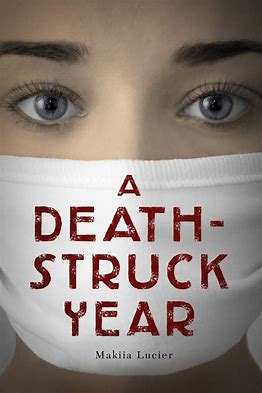
Title: A Death Struck Year
Author: Makaii Lucier
Publisher: Clarion Books, 2016
Cleo Berry is 17 years old and living at boarding school in Portland, Oregon when the Spanish Flu strikes. With her family traveling in California, and the threat of illness bearing down, Cleo makes the decision to sneak back to her home. Desperate to find a way to help, Cleo joins the American Red Cross. As the Spanish Flu sweeps through her city, Cleo finds an inner strength and purpose she didn’t know she had.
A Death Struck Year is set during the real-life Spanish Influenza pandemic of 1918, which killed millions world-wide. Nation-wide restrictions were put in place for the first time in the U.S., and the country faced tremendous challenges. By reading Cleo Berry’s story, you can get a glimpse of the challenges people faced during this trying time. Special attention can be paid to how a teenager reacted to her fears and hopes, as well as how the city’s attempts to protect its people worked and did not work.
#2 Year of Wonders by Geraldine Brooks
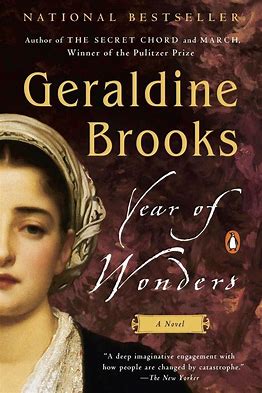
Title: Year of Wonders
Author: Geraldine Brooks
Publisher: Penguin Books, 2001
Anna Firth is 18 years old and the mother of two young sons when the Black Plague is carried to her village in 1666. The villagers make the impossible choice to self-quarantine, cutting themselves off from any supplies or outside help. As the plague invades every household, people turn on each other and begin a witch hunt against any person they feel could have caused the plague.
Year of Wonders explores how a small village in rural England was affected by the 1666 outbreak of Black Plague. Anna Firth is a complex character who faces tremendous loss yet manages to help bring her community together. The novel highlights the psychological effects of fear, isolation, and a lack of understanding of disease. One can learn a lot about the challenges of quarantining an entire community as well as the importance of not panicking when faced with fear.
#3 Earth Abides by George R. Stewart
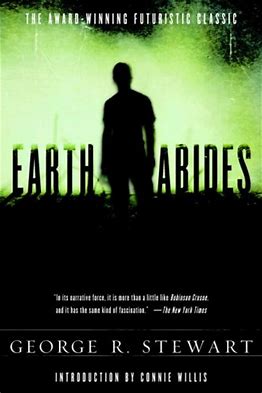
Title: Earth Abides
Author: George R. Stewart
Publisher: Ballantine Books, 1949
Isherwood “Ish” Williams is one of the few people on Earth to survive a horrendous pandemic. Ish meets other survivors as he scavenges for food and supplies. Together, they form a new community and fight to find hope while trying to hold on to civilization.
Earth Abides was written just after WWII, when the world was an uncertain place for many people. The struggle to band together and rebuild was a very real, very recent experience for many readers. Earth Abides presents the reality that humans are often at the root of harm to each other and that one may have to go to extreme measures to protect themselves and their loved ones. Ish also faces the question of which traditions and skills are truly important and worth holding onto.
#4 Station Eleven by Emily St. John Mandel
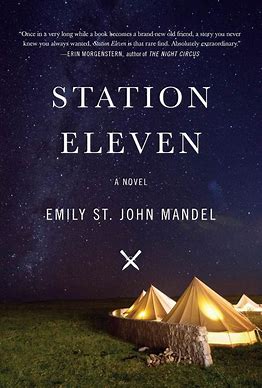
Title: Station Eleven
Author: Emily St. John Mandel
Publisher: Vintage Books, 2014
Kirsten Raymonde is a young child when a flu pandemic brings about the end of civilization. Twenty years later, Kirsten travels the country with the Traveling Symphony, a group of actors and musicians determined to keep art and humanity alive. While traveling, they encounter a man who threatens their survival.
Through well woven flashbacks, Station Eleven paints a vivid picture of the end of our known world. The conflicts people face in the initial waves of the pandemic, such as the struggle to find food and shelter and the breakdown of modern communication are highlighted. The travelers’ journey presents readers with an idea of what the world would be like without social media, TV, cars, electricity, medicine, and running water. Their conflict with a violent prophet explores what lengths people will go to protect their way of life.
#5 The Last Town on Earth by Thomas Mullen
Title: The Last Town on Earth
Author: Thomas Mullen
Publisher: Random House, 2006
Phillip Worthy is a teenager when the Spanish flu epidemic finds its way to his town in 1918. After the town agrees to quarantine itself from the outside world in hopes of saving itself from the virus, Phillip volunteers for watch duty on the town’s borders. While on duty, Phillip faces decisions no young person should have to make. As people in town begin to fall ill, they begin to turn on each other and the true natures of individuals are revealed.
Thomas Mullen uses a fictional setting and real epidemic to explore the effects of isolation, fear, and desperation on everyday people. Phillip Worthy faces an impossible choice and its consequences, young love, and the destruction of his town. One can learn a great deal about the consequences of guilt, fear, and grief from Mullen’s work. Both the practical and psychological aspects of quarantine are presented.
#6 The Hot Zone by Richard Preston
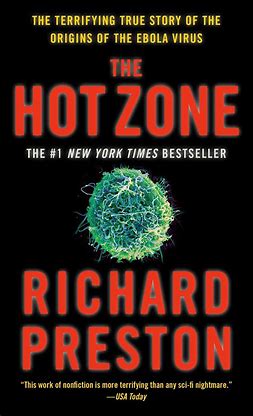
Title: The Hot Zone
Author: Richard Preston
Publisher: First Anchor Books, 1995
The Hot Zone weaves together the stories of civilians, military personnel, and scientists as they discover, research, and fight the real-life events of outbreaks of the filoviruses Ebola and Marburg in Africa and the United States. Written in four parts, the book is a work on non-fiction that presents the history of filoviruses, Marburg outbreaks in Central Africa and Virginia, and the Ebola outbreak of 1993-1994 in Central Africa.
The Hot Zone is, alarmingly, a true story, though Preston states he did change some names during the writing of the book. The book provides a history of filoviruses that is easy to comprehend and keeps readers’ interests in the topics by presenting factual events in the form of a novel. One can learn a great deal about what symptoms a filovirus causes, how they spread, and what responses communities and the military take to contain them. Readers are given a true picture of what an outbreak of a terrifying virus looks like and what steps must be taken to prevent the spread of a deadly contagion.
#7 World War Z by Max Brooks

Title: World War Z
Author: Max Brooks
Publisher: Broadway Paperbacks, 2006
Written as a series of interviews compiled by a journalist, World War Z tells the story of the worldwide outbreak of the Zombie Virus. Told by the men and women who witnessed the war firsthand, the stories shift from the fear of the initial outbreaks, the hope that surges as humans begin to take back their world, and the relief as the rebuilding of countries becomes a reality.
No pandemic prep reading list would be complete without the fictional story of World War Z, the zombie apocalypse. Written as a collection of stories gathered from all corners of the globe, World War Z paints a realistic picture of the end of the modern world. It starts with stories of the initial outbreaks and the Great Panic as the Zombie Virus spreads. As the pandemic spreads out of control, the stories shift to tales of evacuation and a world-wide military and civilian fight against the hordes of zombies. The complications of the breakdown of modern transportation and communication are made clear. As humans manage to fight back and reclaim the land and oceans mile by mile, the stories turn into accounts of what it would take to rebuild our civilization after complete devastation.
 Katherine Evans